Why Anthropology?
Students studying anthropology develop diverse conceptual and analytical tools, such as critical thinking, research, analysis, and writing to examine why people do what they do from the deep past to the daily present. Simultaneously, they learn to see their own social worlds in a broader, truly global light.
Students gain the following marketable proficiencies, which are applicable to all career paths:
Holistic Professional Development
Fundamentally, students gain a deeper understanding of what it means to be human, to appreciate people from an array of backgrounds, and to understand the cultural legacies that shape their own lives.
Past, Present, and Future Perspectives
Students investigate human activity past and present to answer modern questions and engage with their own perspectives on a variety of issues.
Local and Global Immersive Experiences
Students work with living, active cultures at a variety of scales, from their own backyard to global interactions.
Top-Down and Bottom-Up Approaches
Students examine cultural practices and patterns at different levels, with radiating effects from the individual to international, and vice versa.
Interdisciplinary Connections
Anthropologists use all methods at our disposal to examine humanity, including chemistry, genetics, statistics, biology, geographical information systems, remote sensing, philosophy, art, history and more.
Diverse Analytical Skills and Approaches
Students become proficient in utilizing both quantitative and qualitative methods in their investigations in a wide array of interdisciplinary approaches.
Students as Active Participants
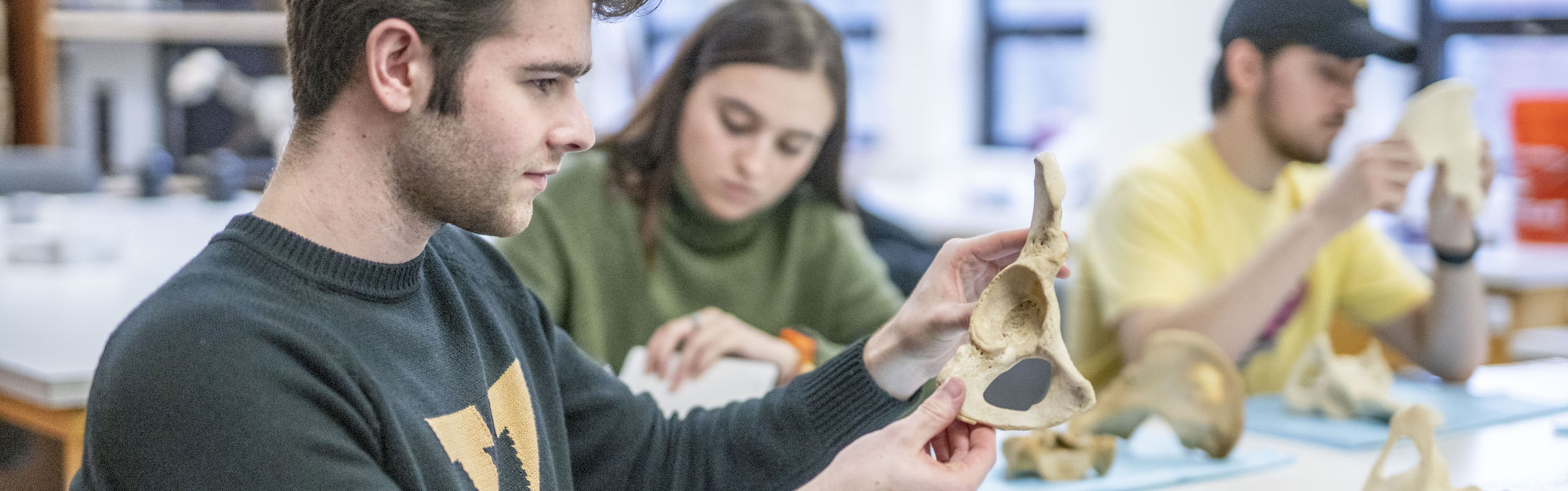
Students and faculty work together in the classroom and in the field in a variety of ways that encourage student learning and engagement.
Diversity of Worldviews
Through all the above, students will come away with an enhanced understanding and appreciation of the wide array of peoples and experiences that will aid them in their future trajectories.