
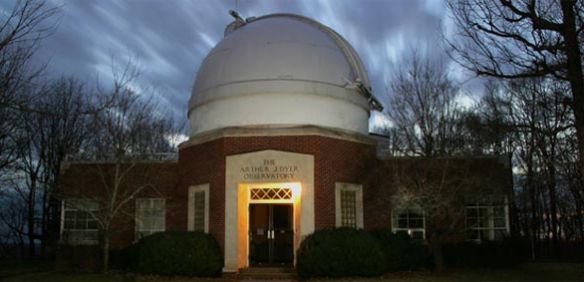
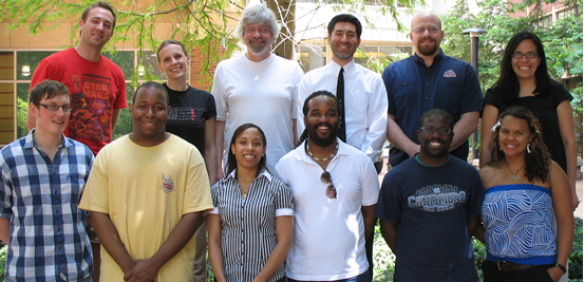

The Astronomy Group is a part of the Department of Physics & Astronomy at Vanderbilt University. Both theoretical and observational research is carried out at Vanderbilt, with the work carried out at various national, international and space-platform facilities. In addition, Vanderbilt helps operate the KELT survey for transiting extrasolar planets, and members of the group are active participants in the Kepler and SDSS 3 collaborations, as well as preparing for future large-scale projects like TESS and LSST. The on-campus ACCRE cluster, with over 4000 CPUs, provides the resources for computational astrophysics.
Contact Us
The Astronomy Group
is a part of the
Physics & Astronomy DepartmentPhone
(615) 322-2828Fax
(615) 343-7263Email
physics-astronomy @vanderbilt.eduOn Campus
6301 Stevenson Center
(view map)Mailing Address
Physics & Astronomy Department
Vanderbilt University
6301 Stevenson Center
Nashville, TN 37235