Author

Colloquium – Talk by Dr. Yvonne Lai(University of Nebraska-Lincoln): April 9, 2026
Mar. 31, 2026—April 9, 2026 (Thursday) 4:10-5:00 PM SC 5211 Dr. Yvonne Lai– University of Nebraska-Lincoln Unreasonably effective, and unreasonably taught? When scholars wrote that mathematics is “unreasonably effective”, they meant the application of mathematical structure for the doing of the sciences and engineering; but what about for the teaching of mathematics in and for the sciences?...

Colloquium – Talk by Dr. Matthew Baker (Georgia Institute of Technology): April 2, 2026
Mar. 31, 2026—April 2, 2026 (Thursday), 4:10-5:00 PM SC 5211 Dr. Matthew Baker– Georgia Institute of Technology Matroids with coefficients and Lorentzian polynomials In the first part of the talk, I will briefly survey the theory of matroids with coefficients, which was introduced by Andreas Dress and Walter Wenzel in the 1980s and refined by the speaker...

Colloquium – Talk by Dr. Feng Xu (University of California, Riverside): March 26th, 2026
Mar. 25, 2026—March 26, 2026 (Thursday), 4:10-5:00 PM SC 5211 Dr. Feng Xu- University of California, Riverside Subfactors and Conformal Field Theory This talk reviews some of our earlier results in the operator algebraic framework of Chiral CFT, motivated in part by the problem of understanding the large class of subfactors that arise naturally in this setting....

Colloquium – Talk by Dr. Joseph Rabinoff (Duke University): March 19th, 2026
Mar. 13, 2026—March 19, 2026 (Thursday), 4:10-5:00 PM SC 5211 Dr. Joseph Rabinoff-Duke University The Chudnovsky Brothers’ Formula for 1/pi and Formalization In 1988, David and Gregory Chudnovsky published a remarkable infinite sum formula for 1/pi. This sum converges extremely quickly, with each summand providing approximately 10 new decimal digits of precision; for this reason, it is...

Colloquium – Talk by Dr. Jennifer Hom: February 19th, 2026
Feb. 16, 2026—February 19, 2026 (Thursday), 4:10 pm Dr. Jennifer Hom, Georgia Institution of Technology Progress in low-dimensional topology using Heegaard Floer homology Low-dimensional topologists study knots, surfaces, 3-manifolds, and 4-manifolds. How many crossing changes does it take to untie a knot? Which 3-manifolds have simple descriptions? How many different 4-dimensional Euclidean spaces are there? We will...
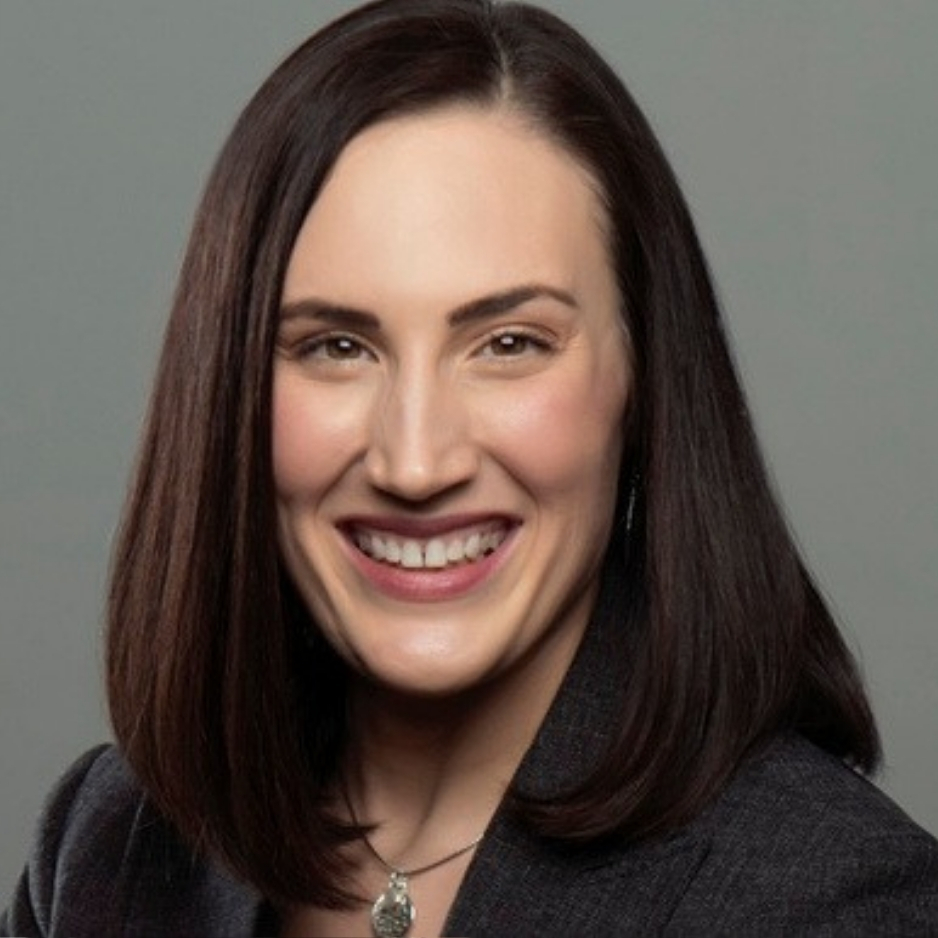
Colloquium – Talk by Dr. Christine Berkesch: January 29th, 2026
Feb. 15, 2026—January 29, 2026 (Thursday), 4:10-5:15 PM Dr. Christine Berkesch, University of Minnesota Geometry and Multigraded Polynomials In a graded polynomial, all terms have the same degree. For instance, $x^3+x^2y+z^3$ is graded of degree 3. There is a long and rich history tying the geometry of projective varieties and the algebra of graded polynomials and modules....

Colloquium – Talk by Dr. John Urschel: October 23, 2025
Oct. 14, 2025—October 23, 2025 (Thursday), 4:10 pm Dr. John Urschel, Massachusetts Institute of Technology Nodal Statistics for Graphs and Matrices The study of discrete nodal statistics, that is, data regarding the zeros of Laplacian eigenvectors, provides insight into structural properties of graphs and matrices, and draws strong parallels with classical results in analysis for Laplacian eigenfunctions....
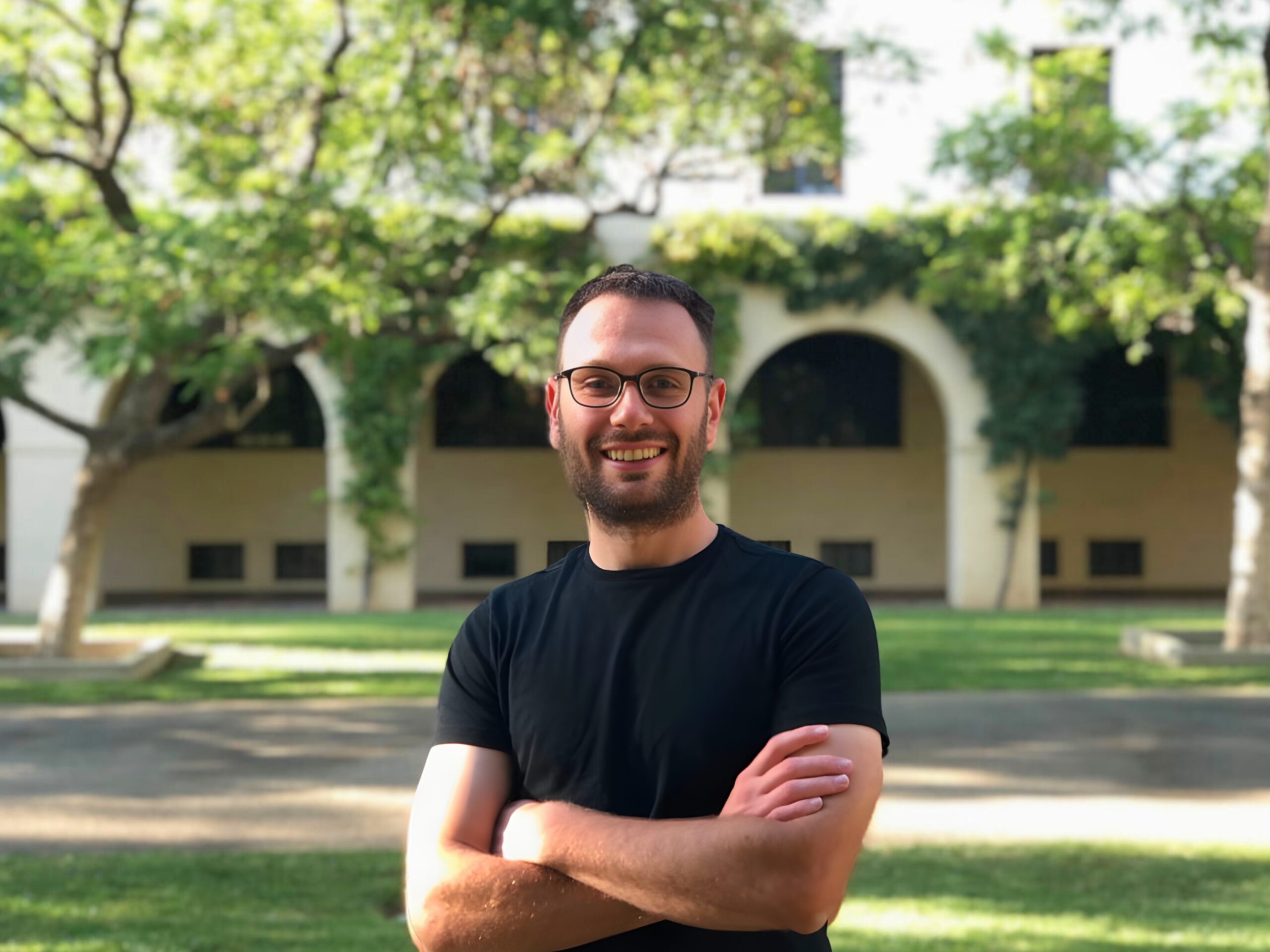
Colloquium – Talk by Alexander Dunn: October 7, 2025
Sep. 30, 2025—October 7, 2025 (Wednesday), 4:10 pm Alexander Dunn, Georgia Institute of Technology Recent progress on Gauss sums and primes Large sieve inequalities are a fundamental tool used to investigate prime numbers and exponential sums. In this Colloquium I will explain my work that resolves a 1978 conjecture of S. Patterson (conditional on the Generalized Riemann hypothesis) concerning the bias...

Colloquium – Talk by Peter Bubenik: October 2, 2025
Sep. 30, 2025—October 2, 2025 (Thursday), 4:10 pm Dr. Peter Bubenik, University of Florida A guided tour of Applied Algebraic Topology Topological data analysis develops methods based on algebraic topology to provide insight into the structure of scientific data. Often these tools come with theorems guaranteeing that their output is stable with respect perturbations of the input....

Colloquium – Talk by Wanlin Li: September 25, 2025
Sep. 30, 2025—September 25, 2025 (Thursday), 4:10 pm Wanlin Li, Vanderbilt University Supersingular Primes A supersingular elliptic curve is a genus 1 curve defined over a finite field with a particularly large endomorphism ring. In this talk, I will discuss the definition and properties of supersingular elliptic curves and their higher dimensional generalizations. In particular, for a...

Colloquium – Talk by Spencer Dowdall: September 25, 2025
Sep. 30, 2025—September 25, 2025 (Thursday), 4:10 pm Spencer Dowdall, Vanderbilt University Counting Mapping Classes by Type In the classic “lattice point counting problem” for a group acting on a metric space, the goal is to count the number of orbit points of the action in a ball of radius R, and to find the growth rate...