
Accolades
Faculty Publications and Awards

Professor Shatema Threadcraft
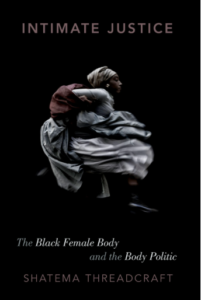
‘Intimate Justice’ charts the long and still incomplete path to black female intimate freedom and equality—a path marked by infanticides, sexual terrorism, race riots, coerced sterilizations, and racially biased child removal policies.
In order to challenge prevailing understandings of freedom and equality, author Shatema Threadcraft considers the troubled status of black female intimate life during four moments: antebellum slavery, Reconstruction, the nadir, and the civil rights and women’s movement eras. Taking up important and often overlooked aspects of the necessary conditions for justice, Threadcraft’s book is a compelling challenge to the meaning of equality in American race and gender relations. Buy the book here.
Winner 2017 Best Book Award, American Political Science Association’s Race, Ethnicity and Politics Organized Section, Race and Political Theory
Winner 2017 Sara A. Whaley Book Prize, National Women’s Studies Association
Winner 2017 W.E.B. Du Bois Distinguished Book Award, National Conference of Black Political Scientists
 Professor Rebecca Epstein-Levi
“Rebecca Epstein-Levi’s When We Collide (2023) brings rabbinic texts to life, literally. Epstein-Levi looks at how rabbinic texts match up against life, how they illuminate, and are illuminated by, lived sexual experience in the 21st century. Epstein-Levi is not content to stay in the comfortable realm of scholarly theory, though she does that too.
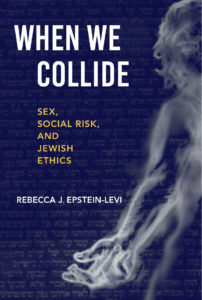 She gets into the nuts and bolts of sex – how people actually behave, not how they like to say they behave, or how think they should behave, but how they actually do – to find insights from canonical Jewish traditions that can serve as guidance. Those insights do not comefrom the usual rabbinic-text suspects, however, but from texts that on the face of it are entirely unrelated to sex – texts on purity, texts with stories about rabbis interacting with other rabbis, texts that issue laws of capital punishment. Epstein-Levi finds in these far-flung and faraway ancient texts the resources – or as Epstein-Levi calls it, the dialogue partners – for a fresh sexual ethics today.”
— Beth Berkowitz, Ingeborg Rennert Chair of Jewish Studies and Professor of Religion, Barnard College