Research Overview
CSET faculty conduct wide-ranging, vital research that connects the public to the marvels of modern science.
This interdisciplinary research crosses traditional academic approaches with the methods of the creative arts to help our students become better communicators of discovery, while engaging the public. Our faculty lead projects exploring everything from media narratives and plain language to digital inclusion, data ethics, and the cultural dimensions of science—each designed to better understand how science is communicated, interpreted, and acted upon in the real world.
Click on the links below to learn more about our research endeavors!
Faculty Publications
Planet in Peril: Humanity’s 4 Greatest Challenges & How We Can Overcome Them
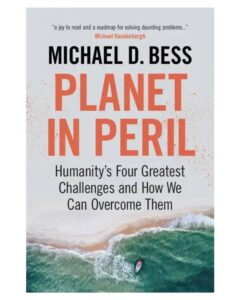
The top four mega-dangers facing humankind are climate change, nuclear weapons, pandemics, and artificial intelligence. Michael Bess, Chancellor’s Professor of History, outlines the solutions that have been tried, and analyzes why they have thus far fallen short. These four existential dangers present a special kind of challenge that urgently requires planet-level responses, yet today’s international institutions have so far failed to meet this need.
Literature, Science, & Public Policy: From Darwin to Genomics
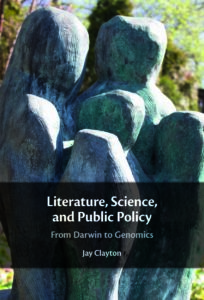
In this interdisciplinary book, Dr. Jay Clayton explores how literature shapes public understanding of scientific controversies—from cloning and GMOs to gene editing and genomics. Drawing on works by authors like H.G. Wells, Octavia Butler, and Margaret Atwood, the book shows how fiction can illuminate the human dimensions of science and offer powerful insights for shaping public policy. A compelling case for the role of the humanities in science communication and policymaking.
The Fate of Food: What We’ll Eat in a Bigger, Hotter, Smarter World
Climate models show that global crop production will decline every decade for the rest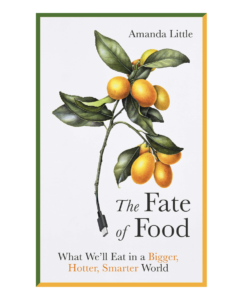 of this century due to drought, heat, and flooding. Water supplies are in jeopardy. Meanwhile, the world’s population is expected to grow another 30 percent by midcentury. So how, really, will we feed nine billion people sustainably in the coming decades? Amanda Little, writer-in-residence of English, spent three years traveling through a dozen countries and as many U.S. states in search of answers to this question. Her journey took her from an apple orchard in Wisconsin to a remote control organic farm in Shanghai, from Norwegian fish farms to famine-stricken regions of Ethiopia.
Math Art: Truth, Beauty, & Equations
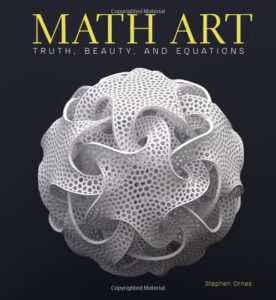
The worlds of visual art and mathematics come together in this volume as science writer and professor, Stephen Ornes explores the growing sensation of math art, presenting more than 80 pieces, including a crocheted, colorful representation of non-Euclidian geometry that looks like sea coral, and a 65-ton, 28-foot-tall bronze sculpture covered in a space-filling curve. From 3D-printed objects that give real form to abstract mathematical theories, to mystic fractals, to Andy Warhol as a solution to the Traveling Salesman Problem, these artworks embody some of strangest, most beautiful relationships among numbers and across dimensions.