Author

John Jumper BS Math ’07 wins Nobel Prize
Jul. 16, 2025—John Jumper, who received a BS degree in Mathematics and Physics from Vanderbilt in 2007, has won a share of the 2024 Nobel Prize in Chemistry. Jumper works as American Director at Google DeepMind Technologies. His team created the AI model AlphaFold, which predicts protein structures from their amino acid sequence. About his work Jumper...

Colloquium – Talk by Ronnie Pavlov: April 2, 2025
Apr. 2, 2025—April 2, 2025 (Wednesday), 4:10 pm Ronnie Pavlov, University of Denver Title: “Complexity in symbolic dynamical systems” There are various ways in which one can describe the simplicity/complexity of a dynamical system. One is in terms of qualitative dynamical properties, such as periodicity/equicontinuity (simple) or mixing/independence (complex). For symbolically defined dynamical systems called subshifts, there is...
Colloquium – Talk by Steve Trettel: March 20, 2025
Mar. 20, 2025—March 26, 2025 (Wednesday), 4:10 pm Steve Trettel, University of San Francisco What do 3-manifolds Look Like? Thurston’s Geometrization Theorem, later proved by Perelman, describes 3-manifolds in terms of geometric building blocks. Each manifold decomposes into pieces modeled on one of just eight homogeneous 3-dimensional spaces, known as the Thurston geometries. In this talk, we...
Shanks Lecture: May 19-22, 2025
Mar. 10, 2025—May 19-22, 2025, with Shanks Lecturer Doron Lubinsky Constructing Functions 2025 Celebrating Ed Saff’s 80th birthday Conference Website
Topology and Group Theory Seminar: April 16, 2025
Mar. 9, 2025—Speaker: Robbie Lyman (Rutgers) Title: Graphical models for groups Abstract: In geometric group theory, we love groups and graphs. Every (abstract) group has (many) Cayley graphs, each one associated with a choice of a generating set. Recently I’ve been curious about topological groups, inspired by the budding theory around and community of people inspired by mapping class...
Topology and Group Theory Seminar: April 9, 2025
Mar. 9, 2025—Speaker: John Ratcliffe (Vanderbilt) Title: The G-index of a spin closed hyperbolic 4-manifold M Abstract: In this talk, we will show how to compute the G-index of a spin closed hyperbolic 4-manifold M for a group G of symmetries of a spin structure on M. As an example, we will compute the G-index for the group G of symmetries of the fully symmetric spin structure on...
Topology and Group Theory Seminar: April 2, 2025
Mar. 8, 2025—Speaker: Talia Fernos (Vanderbilt) Title: Lattice envelopes and groups acting AU-acylindrically on products of hyperbolic spaces Abstract: In this joint work with Balasubramanya, we explore the capacity for a group acting AU-acylindrically on a finite product of delta-hyperbolic spaces to satisfy three properties introduced by Bader, Furman, and Sauer. When satisfied, these properties restrict the potential ambient group...
Topology and Group Theory Seminar: March 26, 2025
Mar. 7, 2025—Speaker: Caglar Uyanik (University of Wisconsin, Madison) Title: TBA Abstract: TBA Host: Spencer Dowdall
Topology and Group Theory Seminar: March 19, 2025
Mar. 6, 2025—Speaker: Oishee Banerjee (Florida State University) Title: TBA Abstract: TBA Host: Dan Margalit
Topology and Group Theory Seminar: March 5, 2025
Mar. 5, 2025—Speaker: Madeline Brandt (Vanderbilt) Title: TBA Abstract: TBA
Geometry and Topology Seminar: February 28, 2025
Feb. 28, 2025—Speaker: Zhonghui Sun (Michigan State University) Title: Equivariant Bicategorical Shadows and Traces Abstract: Bicategorical shadows, defined by Ponto, provide a framework that generalizes (topological) Hochschild homology. Bicategorical shadows have important properties, such as Morita invariance, and allow one to generalize the symmetric monoidal trace to a bicategorical trace. Topological Hochschild homology (THH), an essential component of the trace methods...
Topology and Group Theory Seminar: February 26, 2025
Feb. 26, 2025—Speaker: Matt Zaremsky (SUNY Albany) Title: Aut(Fn) satisfies the Boone-Higman conjecture Abstract: The Boone-Higman conjecture (1973) predicts that a finitely generated group has solvable word problem if and only if it embeds in a finitely presented simple group. The “if” direction is true and easy, but the “only if” direction has been open for over 50...
Topology and Group Theory Seminar: February 19, 2025
Feb. 19, 2025—Speaker: Denis Osin (Vanderbilt) Title: Simple p-adic Lie groups with abelian Lie algebras Abstract: For each prime p and each positive integer d, we construct the first examples of second countable, topologically simple, p-adic Lie groups of dimension d with abelian Lie algebras. This answers a question asked by P.-E. Caprace and N. Monod. In my talk, I will survey the necessary background material and...
Topology and Group Theory Seminar: February 12, 2025
Feb. 12, 2025—Speaker: Jesse Peterson (Vanderbilt) Title: Property HaHaHaHaHaHaHaHaHaHaHa… HaHaHaHaHaHaHaHaHa… HaHaHaHaHaHa… HaHaHa… Abstract: A seminal result of Haagerup from 1979 is that the word length function with respect to a free generating set on a free group is conditionally negative definite. Groups possessing a proper conditionally negative definite function have since been said to have the Haagerup property and...
Topology and Group Theory Seminar: February 5, 2025
Feb. 5, 2025—Speaker: Itamar Vigdorovich (UCSD) Title: Effective mixed identity freeness for higher rank lattices and applications to C*-algebras Abstract: An identity on a group G is a word w that holds throughout the entire group. If w is allowed to include coefficients from G (not just variables), it is called a mixed identity. We show that a lattice Γ in PSL(n, R) has no non-trivial mixed identities in a quantitative and uniform...

Katherine Booth awarded NSF Postdoctoral Fellowship
Feb. 4, 2025—Katherine Booth was awarded a Mathematical Sciences Postdoctoral Fellowship from the National Science Foundation in February 2025. This is a highly prestigious award, given to about 40 mathematicians around the country each year. Katherine is a non-degree-seeking graduate student at Vanderbilt, and will receive her Ph.D. from Georgia Institute of Technology in Spring 2025. Katherine’s research...
Topology and Group Theory Seminar: January 29, 2025
Jan. 29, 2025—Speaker: Abdul Zalloum (University of Toronto) Title: From coarse to fine: a generalized Sageev’s construction in hyperbolic spaces Abstract: I will discuss a construction that starts with a set S, a collection of bi-partitions on S called walls, and produces a spectrum of metric spaces, including Helly graphs, hyperbolic spaces, and injective metric spaces. The resulting space depends on the combinatorics of the walls; for example, if pairs...
Topology and Group Theory Seminar: January 22, 2025
Jan. 22, 2025—Speaker: Mike Mihalik (Vanderbilt) Title: Stallings’ group is simply connected at infinity Abstract: For n ≥ 2, let Bn denote the kernel of the homomorphism from the direct product of n-copies of the free group on two generators to the group of integers which sends all generators to the generator 1. The groups Bn are called the Bieri-Stallings groups and Bn is of type Fn-1 but not Fn. Classical...

Dr. Lorenzo Gavassino featured in Discover Magazine
Jan. 16, 2025—The research of Dr. Lorenzo Gavassino, postdoctoral researcher in the department, and member of the VandyGRAF initiative has recently been featured in Discover Magazine: https://www.discovermagazine.com/the-sciences/mathematician-reveals-strange-new-enigmas-for-time-travelers According to the article, Lorenzo’s article shows that “The laws of physics suggest [a time traveler’s] memory would be wiped clean as soon as they returned to the present.” Dr....
Prof. Marcelo Disconzi Speaks at Dyer Observatory
Dec. 2, 2024—Prof. Marcelo Disconzi gave a lecture at the Dyer Observatory on Nov 21, 2024. The title of his talk was: When Mathematics & Physics Collide: Black-Hole Mergers, Neutron Stars, and the Theory of Relativity. From Marcelo’s abstract: “In 1915, Einstein developed the general theory of relativity, a theory born out of what he called his...

Math Department Makes Chocolate Hot!
Nov. 24, 2024—On October 24, 2024, the Math Department hosted a Hot Chocolate and Hot Apple Cider extravaganza at the department. In the Stevenson 1 lobby, students were treated to tasty beverages, made hot to go! Students, faculty, and staff also participated in a design-your-own-pumpkin contest. The winner of the contest was Griffin Sims, and undergraduate who...
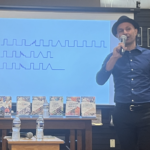
Prof. Marcelo Disconzi appears at Parnassus Bookstore
Nov. 24, 2024—Professor Marcelo Disconzi appeared at a meet-the-author event, discussing his book “I’m a Mathematician Now!” The event was held on October 21, 2024 at the Parnassus Bookstore in Green Hills, the flagship bookstore owned by famed author Ann Patchett. Prof. Disconzi appeared alongside Prof. Larisa DeSantis, Associate Professor in the Departments of Biological Sciences and...
Colloquium – Talk by Dick Canary: November 22, 2024
Nov. 22, 2024—November 22, 2024 (Friday), 4:10 p.m. Dick Canary, University of Michigan An invitation to Anosov representations Fuchsian groups arise naturally as groups of covering transformations of hyperbolic surfaces. One may view them as images of discrete faithful representation of free groups and surface groups into PSL(2,R). The study of hyperbolic surfaces and deformation spaces of...
Prof. Dan Margalit and Isaiah Williams ’25 Unravel Mysteries of Math
Nov. 17, 2024—A new video made by the College of Arts & Science communications team aims to answer some of the frequently searched questions about mathematics. Prof. Dan Margalit, Chair of Mathematics and Stevenson Chair, along with undergraduate Isaiah Williams, class of ’25 fielded questions and answered them in the madcap video made by Liz Chagnon. The...
November 15, 2024: Subfactor Seminar
Nov. 15, 2024—AU-Acylindricity in Higher Rank, and its Accompanying (Imperfect) Semi-Simple Dictionary – Location- SC1432 November 15, 2024 (Friday), 4:10 pm Talia Fernós, University of North Carolina, Greensboro AU-Acylindricity may be viewed as generalizing the type of action a lattice enjoys on its ambient space. In a recent joint work with S. Balasubramanya, we extend the theory...