Math Department introduces new Core class “Math for the Misinformation Age”
This fall, Vanderbilt students encountered a new way to study mathematics—one centered not on equations in isolation, but on the numbers, charts, and claims that surround us every day. Mathematics for the Misinformation Age, designed and taught by Dr. Sean McAfee, debuted in Fall 2025 as one of the inaugural offerings in the College of Arts & Science’s Exploratory Core curriculum. The course is the first of its kind in the Department of Mathematics and reflects a growing campus-wide emphasis on data literacy and critical thinking. Unlike other math courses, which may focus on more abstract mathematics and leave the onus of application on students outside the classroom, the real-world examples in this course take center stage.
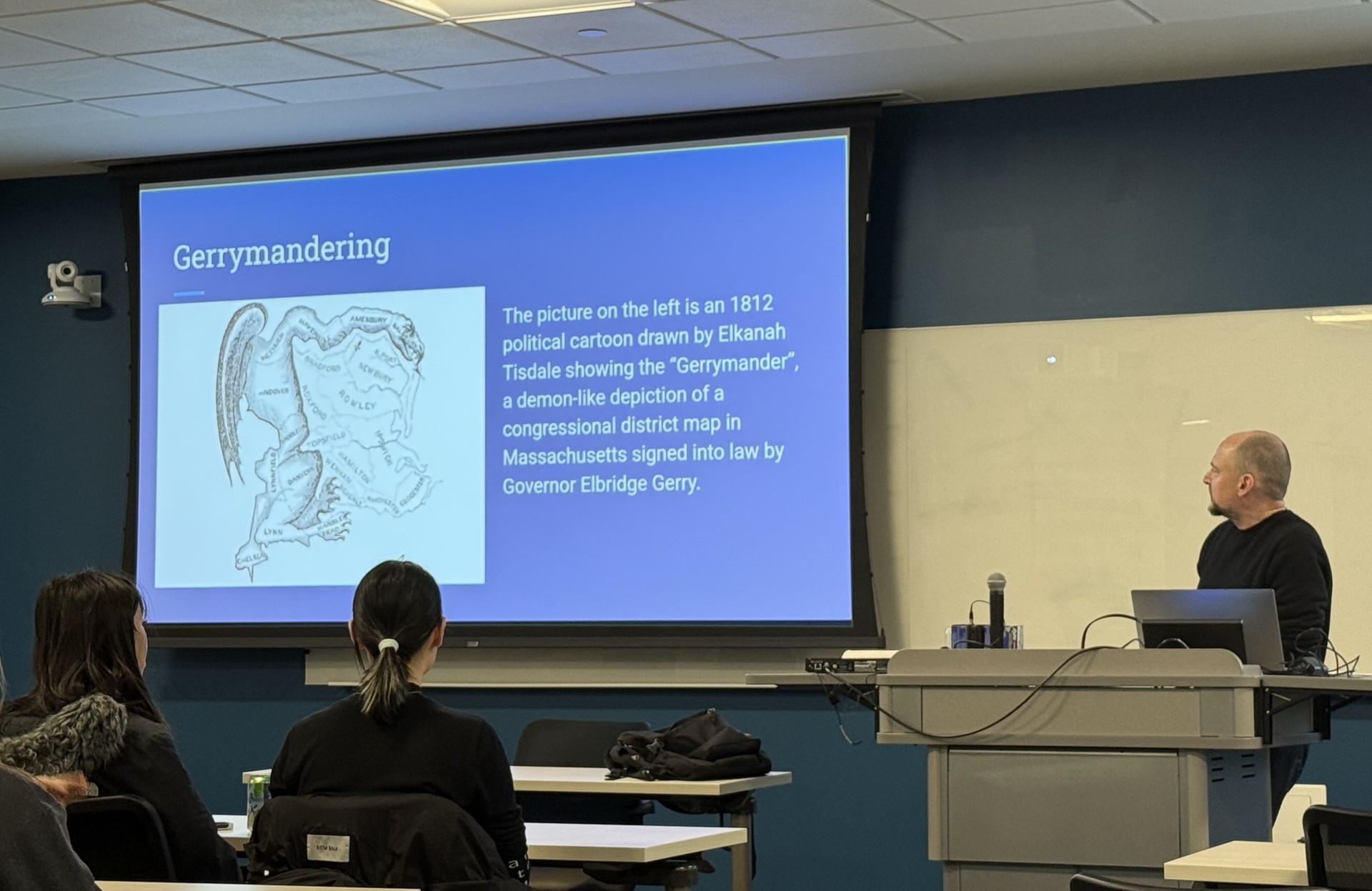
Across the semester, students learn to critique data visualizations and infographics, recognize common fallacies that distort decision-making, and understand core ideas from probability and statistics, such as Bayesian statistics, confidence intervals, and hypothesis testing. The course also explores the mathematics behind modern rating systems (from Rotten Tomatoes to Rate my Professor), the role of expected value and risk in finance, and the promises and pitfalls of mathematical modeling and AI tools. Special topics such as gerrymandering illustrate how quantitative methods can affect important questions of fairness.
While the focus of this class is mathematics, it is not solely intended for STEM majors. This class is part of a university-wide effort to build out the interdisciplinary Core curriculum, and it is designed for students across majors who want to strengthen their quantitative toolboxes. All of us can benefit from increased data literacy, whether we study math directly or not.
Jacqueline Walsh, a current student in the course, is a Communications major and English minor. She shared that the class has changed the way she looks at graphs in the news and has even influenced how she prepares data visualizations for presentations in her other courses. Just as importantly, it has deepened her appreciation for the power of mathematics. She highlighted how this is a math class built around discussion and engagement and how the collaborative environment in the classroom enhanced her understanding of the material. In an average class, students are expected to interact with one another and the instructor, engaging with the core ideas in real time.
Jacqueline recommends the course for non-math majors interested in thinking mathematically in their daily lives and future careers. Assignments throughout the semester prompted students to actively apply what they were learning to the real world by finding examples of mathematical misinformation in their everyday lives.
Her most memorable takeaway? “Don’t gamble.” She elaborated that their discussions of probability and statistics had them study casino games to understand why the house always wins.
No prerequisites are needed for this course, aside from curiosity about how math shapes the world around us and a willingness to engage with these big ideas. If this course sounds like a good fit for you or somebody you know, it will be offered again in Fall 2026.