Interview with Omatayo Fasan, Class of 2024
How GSS Shapes the Future of Healthcare
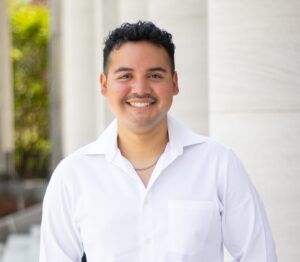
By Vincent Castillo
When Dr. Christin Essin announced that our Gender and Sexuality Studies (GSS) senior seminar would be interviewing alumni, I was excited but also curious about what it could look like for a GSS major or minor. I had spoken to consultants, nonprofit professionals, and analysts, but many of them were the typical business or business-adjacent majors as expected. When I found out that I had the opportunity to interview Omotayo (Tayo) Fasan (BA ’24), a former Medicine, Health, and Society (MHS) major and GSS minor, I was thrilled since her background was similar to my own, studying MHS and Human & Organizational Development with a GSS minor. Through this interview, I learned more about how a feminist framework can shape the practice of care and an essential lens for any field, especially the vast and often dehumanizing area of healthcare.
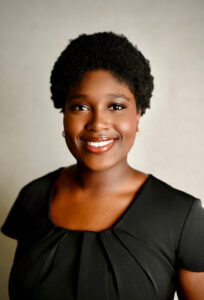
Tayo joined the call after one of her medical school classes, we greeted each other with smiles and introductions before getting into the interview. While at Vanderbilt, Tayo said “[she] concentrated in inequality, intersectionality, and health.” “Most of my GSS classes, like Black Girlhood, Sexual Politics, and Feminist Fictions, taught me how to read the world differently.” Those classes pushed Tayo toward primary care and a commitment to serve gender-marginalized people, trans patients, and women of color, who historically and in the present day have been wronged by medicine. Touching on how research can reproduce inequality, she noted that these groups have been excluded from clinical trials, justified by the idea that menstrual cycles “complicated data.” Her class, Sex and Gender in Everyday Life, had a different narrative: “It’s not complicated,” she told me. “It’s reality, and that’s why it matters.”
Her perspective reminded me of why I was drawn to healthcare consulting in the first place. While I may not be planning to become a practicing medical professional, I will still be interacting with the systems I hope to improve, such as hospitals and public health institutions. Tayo described this awareness as understanding, “who gets left out, whose bodies are standardized, whose stories are considered credible.” This idea bridged the gap between my undergraduate self and an aspiring physician in medical school since we both have to navigate institutions shaped by bias and decide whether we want to replicate or challenge these structures.
In different ways, we are both learning to recognize how policies, protocols, and everyday habits determine who is listened to and who is pushed to the margins. Realizing that made GSS feel less like a set of theories confined to the classroom and more like a toolkit I will carry into every space where decisions about care are made.
After graduating from Vanderbilt, Tayo spent a year as a clinical research coordinator in Philadelphia, where she interviewed patients for studies on how cancer treatment affects the heart. She mentioned how the work was rigorous but deeply human. “The most rewarding moments were when Black women with breast cancer told me they felt safer because I looked like them,” she said. “Representation isn’t abstract, it changes how people heal.” Her honesty about her career challenges was just as striking and reflects the experiences of many others in both different and similar contexts. “Medicine is still conservative. Showing up fully, as a Black lesbian daughter of immigrants, can feel radical.” She laughed softly, then added, “But I see my identities as my strengths. They give me a critical lens, and that makes me a better doctor.”
Tayo’s comments echoed the writings of bell hooks and Audre Lorde, describing how the margin can be a site of insight rather than limitation. “To borrow from hooks,” she said, “what happens when you move the margin to the center?” I thought about how this question applies to everyone’s work, no matter the profession. This approach reframes inclusion as an act of design, where we can craft systems that make people feel they belong. In healthcare, this means creating forms, guidelines, and clinical practices that recognize different bodies and experiences from the start rather than forcing everyone into a single default.
By the end of our conversation, it was clear that GSS had a profound impact on Tayo, serving as the foundation for her medical ethos. She spoke about publishing her first paper, which focused on stigma and relationships among trans women, and how proud she was that her name appeared on research centering those often left out of health studies. “It was my first publication,” she said, smiling. “And it felt right that it focused on trans women’s health.” Her pride was contagious. I found myself reflecting on how my own coursework has flowed into discussions of intersectionality, embodiment, and social power, and how it has reshaped the way I understand the world.
This was something that Tayo expressed beautifully, the connection between critical theory and compassionate action. She quoted theorists because their questions shaped the way she thinks, and she carries those frameworks into her everyday decisions as a future physician. Our conversation reminded me of the importance of a Gender and Sexuality Studies education not only in the humanities but anywhere everyday decisions are made. As we wrapped up, I thanked Tayo for the interview, because through her story I saw how feminist thinking is not an alternative to scientific rigor, but a necessary complement. Too often, feminist approaches are dismissed as subjective or “soft” in contrast to biomedicine, yet Tayo showed how they strengthen scientific work by revealing whose needs have been overlooked. It ensures that moving forward we continue to approach systems with the idea of moving the margins toward the center, one action at a time.