Interview with Mel Pugeda, Class of 2005
GSS and Futures in Finance
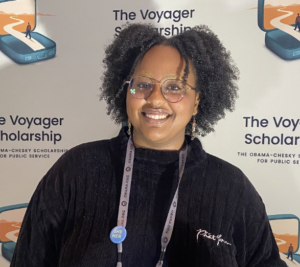
By Sam Mitike
This semester, students in the Gender and Sexuality Studies Senior Seminar worked to highlight alumni whose careers reflect the program’s interdisciplinary spirit. I had the opportunity to speak with Mel Pugeda (BA ’05). A former Human and Organizational Development major and Women’s Studies minor, Mel has built an impressive career in finance. Our conversation moved fluidly between reflections on her time at Vanderbilt, her professional journey, and the lessons she carried from Women and Gender Studies into a corporate world still shaped by gendered expectations. Mel’s warmth, humor, and honesty made an hour’s conversation feel like talking with an old friend. What follows is a narrative account of that conversation—part memory, part reflection, and wholly inspiring.
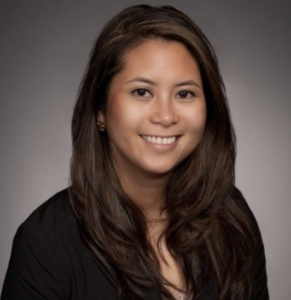
When I sat down with Mel Pugeda (BA ’05) over Zoom, her energy was immediately warm and familiar; she is the kind of person who makes you feel like you’ve known her longer than five minutes. I told her this was my first interview for my senior seminar project. She smiled and said, “I’m excited too. I was an HOD major on the leadership track, if that’s even still a thing, and a Women’s Studies minor.”
I laughed, explaining that it’s now called Gender and Sexuality Studies, and that HOD had gone through a “whole reconstruction.” She nodded knowingly. “That sounds about right,” she said, laughing. “Same program, new names.”
Mel graduated from Vanderbilt twenty years ago and currently works at Intercontinental Exchange, the global market exchange that owns the New York Stock Exchange. “Unfortunately, the abbreviation is ICE—definitely not immigration,” she joked. Her job, however, is far from an ordinary role in finance. She works in the company’s climate group, which produces data on events like hurricanes, floods, and other climate-driven disruptions. “We make it possible to invest in things that aren’t easy to invest in—commodities like corn or cocoa,” she explained. “I head up our client relationships for people who purchase this data to make investment decisions.”
Her career trajectory wasn’t planned. “I’m from Chicago and wanted to go back after graduation,” she said. “At the time, there weren’t many Vanderbilt career resources or Chicago-based recruiters. I had a lot of student debt, and my parents are immigrants, so I just took any job I could get.” That “any job” ended up being an assistant position for a financial advisor at Merrill Lynch. “I had zero knowledge of investing or finance, just a liberal arts degree. But I learned everything about it from the job,” she said. From there, she stayed in financial services, eventually finding her niche in financial data markets.
When I asked if her Women and Gender Studies courses shaped her success, she didn’t hesitate. “Oh yes—those classes honestly changed my life,” she said. They opened her eyes to everyday biases and gendered expectations. “I wasn’t aware of the gender pay gap or the systemic issues that created it until those courses.”
Mel also shared a moment that profoundly shifted her worldview. “Growing up in an Asian Catholic household, I was always taught to be pro-life. One professor said something I’ll never forget: ‘Pro- choice doesn’t mean pro-abortion; it means you support people making their own decisions.’ That completely freed me from a lot of internal conflict, and it has stayed with me ever since.”
As she said this, I couldn’t help but think of my own first Women and Gender Studies class, when we analyzed how women are portrayed in music videos. It felt like a small realization at first but ended up entirely changing how I saw gender in the media. “I’ve never skipped a single GSS class,” I admitted, laughing. “It’s so personal.”
Mel smiled. “Needless to say, I’m pro-choice now. And the fact that my professor broached that topic twenty years ago in Nashville was brave.”
Like many of us, Mel didn’t plan to study gender when she arrived at Vanderbilt. “I took an intro course and was hooked,” she said. “I’d always been aware of women’s rights in a general sense, but not like that.”
When I mentioned that our seminar recently looked through old Vanderbilt student newspapers to see what campus culture was like back then, Mel leaned in. “I’m so intrigued by that!” she said.
I told her that reading those archives had been eye-opening. Vanderbilt in the early 2000s was a very different place. Mel confirmed it. “When I graduated, Memorial Hall was still called Confederate Memorial,” she said. “Students even called me a ‘Yankee,’ and some referred to the Civil War as the ‘War of Northern Aggression.’” She paused, laughing softly. “It was definitely a culture shock, but I found my group and ended up having a good experience.”
Our conversation drifted to campus culture today—Greek life, changing social movements, and the way the Gender and Sexuality Studies department has evolved. When I told her the department had recently moved “to a hidden building off the main campus,” she laughed and said, “I hope those classes never go away. They truly changed my life and still matter so much.”
Before wrapping up, I asked what she finds most rewarding and challenging about her work—and what she’s most proud of. Her answer was thoughtful and honest.
“The biggest challenge? We’re in a very volatile political environment,” she said. “As a woman in finance, it’s still about breaking down barriers and battling microaggressions. Things have gotten better over twenty years, but assumptions remain.” She described how colleagues sometimes assumed that women with children wouldn’t have time for leadership roles. “I even kept the fact that I had children quiet for a while, so I would be taken into consideration for certain opportunities,” she said. “I wish workplaces encouraged men to share domestic responsibilities so those stereotypes would fade.”
Her proudest accomplishment, she told me, isn’t a promotion or a title—it’s fulfilling the hopes of her parents, who immigrated from the Philippines. “They arrived with nothing—no money, no connections,” she said. “I earned my Vanderbilt degree, got an MBA from Northwestern’s Kellogg School, bought property, and built a career completely on my own. I’m still paying off some debt, but I’m financially stable and proud of the life I’ve built.”
Her humility and resilience left me inspired. I told her I was first-generation, too, and that my parents didn’t go to college. “I honestly didn’t even know what Vanderbilt was until I applied through Quest Bridge,” I said. Mel laughed. “I didn’t know either! I’m from Chicago. Who goes to Vanderbilt from there?”
We both laughed again when I added, “My mom was like, ‘What is that?’ and I said, ‘We’ll find out together.’”
As the conversation came to a close, Mel’s warmth and generosity never wavered. “Feel free to reach out at any time,” she said. “If you need advice, a job connection—anything.”
It was the kind of closing line that perfectly captures who she is: grounded, accomplished, and deeply committed to paying forward the lessons she’s learned.