Interview with Leah Field, Class of 2020
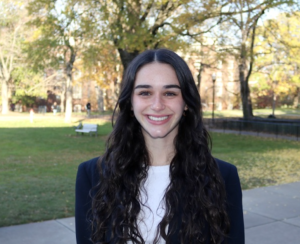
How Feminist Thinking Shapes Legal Paths
By Sarah Wermuth
Going into my interview with Leah Field- Vanderbilt alumni, lawyer, and current Master of Law student in Beijing- I wasn’t just curious about her career path. I was curious about what her story might reveal to me about my own future as an attorney. As a senior majoring in Political Science with minors in Gender and Sexuality Studies (GSS) and English, I’ve spent the last four years learning feminist theories and critical frameworks that have shaped how I understand power and identity. I am planning on attending law school within the next two years and eventually becoming a lawyer who works in the nonprofit sector, and I wanted to understand how a GSS education can contribute to a meaningful career in legal work.

Leah, a recently barred lawyer who graduated from Vanderbilt in 2020 with majors in Political Science and Asian Studies and a minor in Women’s and Gender Studies (WGS), offered the perfect opportunity to explore this question. Do the feminist perspectives and critical framework she learned from WGS continue to influence her research and work in international humanitarian law and investment treaty law? Through the interview, this answer became clear: yes. Leah’s story shows how the skills and perspectives gained through gender studies courses extend far beyond the classroom, shaping not only her academic research and developing legal career but also how she navigates the world.
SW: Hi Leah, this is Sarah Wermuth. Thank you for agreeing to be interviewed! I know you’re busy and it’s late in Beijing, and I don’t want to take up too much of your time. I’m going to ask you some questions about what you’re doing now and how it connects to your time at Vanderbilt. What is your current occupation?
LF: I’m a lawyer. But I recently quit my job. I’m currently pursuing a Master of Law in Beijing. I’m doing a fellowship, conducting independent research, and taking legal classes. I’m also meeting new people and traveling!
SW: What are you researching?
LF: I’m interested in international investment law and arbitration, so topics related to that.
SW: Do the gender studies courses you took at Vanderbilt influence the way you approach your career?
LF: They definitely do! Most of my WGS courses were taught by Professor Ackerly, and one of the biggest things I gained was developing a mentor relationship with her. I’m still in touch; she’s written me many recommendations over the years. It’s the longest lasting thing I’ve gained from my gender studies classes at Vanderbilt.
SW: We recently read “Conducting Feminist Research.” Professor Ackerly came to talk to our class, and I noticed your name was in it!
LF: Yeah! I was a research assistant for her, so I also got to know her outside of a classroom setting.
SW: When did your relationship begin? Was it through the classes you took?
LF: Yes. I took a public policy course with her, and after that, I took Feminist Research.
SW: What are some skills she helped you learn?
LF: I’m still conducting research today for my fellowship, and Feminist Research has shaped the way I approach my work. It’s an extremely valuable skill to know how to ask the right questions to begin one’s research. Generally speaking, it taught me the practical skills of understanding how to design and structure a research question and how to find firsthand sources. More specifically, it taught me to always have a feminist lens, which means being critical. If a source doesn’t mention women, you need to dig deeper to find the role of women in the question you’re pursuing. As a researcher, I must always be aware of feminist issues.
SW: What do you find most rewarding about your research in Beijing?
LF: I’ve written and published a couple papers in law journals so far, about topics in both international humanitarian law and investment treaty law. One of the common themes is criticizing international law through a justice framework. This means questioning how international law norms can be more equitable, and asking if they’re even equitable in the first place. It means questioning where they came from. This is important because a lot of international law has been affirmed by colonial powers. And a big critique of, especially investment treaty law, is that it is biased against developing states. This is the larger research area I’m interested in, and right now, I’m trying to find a narrower question to investigate.
SW: Congratulations on publishing papers! That’s such a big accomplishment! Could you tell me about the biggest challenge you encounter when doing your research?
LF: One of the positives I’ve learned is that I do really love research. Once I get a research question that I’m interested in, I enjoy the process of researching it and finding an answer. The main challenge is figuring out the question. It’s easier when you have a clear inspiration or idea that pops into your head, but at the moment, I don’t have a specific topic that’s hit me in terms of what I want to write about next.
SW: How does your work shape your perception of yourself?
LF: Oooh… That’s a good one! This past year or so, I’ve been reflecting more on what I want my work to be, what work will make me happy in life, and if it’s worth making risky career decisions to pursue those opportunities that I’m passionate about. This came up recently because I had a wonderful job at a big law firm in New York, but I had this itch to do something else. Also, to travel more and go to China where I could work on my Mandarin studies. After reflecting on it, I quit my job, and I’m pretty sure it’s the right call, but it’s still a continuous process of checking in and making sure this is the work I want to do.
…
I expected to walk away from the interview with a clearer picture of how a feminist lens operates within legal scholarship, and while I did learn how Leah’s feminist training guides the questions she asks and the silence she interrogates, I ended up reflecting on far more than her approach to legal research. I found myself grappling with what it means to build a life and career grounded in personal fulfillment rather than stability and predictable success. When Leah described leaving a secure legal job in New York to pursue a fellowship in Beijing that genuinely excited her, I felt both admiration and fear about what I would do in her position. I admired her because she had the courage to step away from a prestigious job to pursue work that aligned more deeply with her passions. However, I also felt unsettled because her story forced me to confront the question of whether I could make a similar choice. Would I be willing to walk away from the job I dream about and hope to secure after law school if another opportunity presented itself? Could I prioritize personal fulfillment over stability when the stakes feel high and the path ahead is unclear? Leah’s willingness to take that risk made me realize how difficult those decisions might be for me someday, but it also reminded me that the kind of career I want to build requires trusting my instincts and being open to the unexpected.
Leah’s candid reflections added depth and authenticity to the interview, and I saw how they embody the lessons of self-reflection that I’ve learned from my own GSS classes at Vanderbilt. Her commitment to reflection shows how feminist thinking is not just an analytical lens but a framework that shapes how we navigate our lives and careers. As someone who wants to work in the nonprofit legal sector, I am aware that the decisions I make about which communities to serve, what questions to ask, and which systems need to be directly challenged will require a sustained commitment to feminist self-reflection and justice-oriented praxis. The lessons and frameworks I’ve learned in GSS have already taught me how to ground my questions in the needs of marginalized communities, but Leah pushed me to think more deeply about how the same logic governing those questions can actively shape the self-reflection that guides the direction and purpose of my legal career. This kind of reflection is not only important to the work I hope to do, but also to the kind of lawyer and activist I want to become. Leah is just one example of how the GSS department empowers students to question structures of power and create meaningful change in their fields, and I hope to carry on her legacy by bringing a feminist, justice-driven approach not only to the kind of law I practice, but also to the career choices I make.