Interview with Rose Capin, Class of 2020
Living What We Learn

by Juliet Curtin
When Professor Essin told our Senior Seminar class that we would be interviewing graduates of Vanderbilt’s Gender and Sexuality Studies (GSS) program (formerly known as Women and Gender Studies) I was ecstatic. I had never had the chance to speak with alumni before, and this felt like a meaningful way to see how my degree might shape life beyond Vanderbilt’s intimate GSS classrooms. Vanderbilt students often dismiss GSS as an “impractical” major, but I wanted to hear directly from someone–living proof–that it’s anything but.
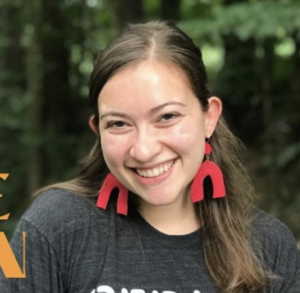
I chose to interview Rose Capin (Class of 2020), whose warmth, humor, and honesty immediately radiated over our zoom call. Since graduating in 2020, “peak COVID,” as they recalled, Rose has navigated the complexities of early adulthood, including working in the nonprofit world, finding an adult queer community, and preparing for law school. Throughout, she has reflected on how GSS shaped her perspectives and approaches to life and their career.
When I asked what she was currently doing, they said, “I am coming to you live with the Real Dose of Reality Adulthood. I got laid off last week. But before that, I was working in the Jewish nonprofit world, doing humanitarian and educational work.” Rose began their career in community service, drawn to hands-on social impact work that reflected her GSS values. She described her service year with Repair the World, a Jewish organization focused on food justice and volunteer mobilization in Atlanta.
“It was such a weird time. Everyone was dealing with a lot more food insecurity, and I learned quickly how messy the real world is compared to the classroom. WGS gave me the tools to sit with that tension, especially when working in communities that didn’t always agree about public health measures. I didn’t want to dictate what the community should do, but I also wanted to be safe” they said.
Rose credits her GSS and MHS coursework with helping her navigate complex social spaces and power dynamics at work. She recalled Intro to LGBTQ Studies as a transformative class that not only shaped her academic path but also affirmed her queerness. They told me it was like “doing the scariest thing of my life. Going into it, I was straight, but by the end of it, I was a lesbian. It was the most sacred and supportive classroom community I had at Vanderbilt. Everyone left their identities at the door, whether that was student athlete, popular girl, or anything else. It reminded me not to have expectations for who people are when I first meet them.”
Their experience is a reminder of how GSS classrooms serve as more than merely academic spaces. They are incubators for identity, critical thinking, and care, as well as a place for students of all backgrounds to communally engage in discussions about gender and sexuality. Talking with Rose reaffirmed what many in the program already know: GSS plays a role far beyond, and arguably more important, than just prepping students for a job. It gives us a vocabulary and frameworks for how to live, lead, and connect with others in an increasingly complicated world that seeks to divide us.
Rose provided one last piece of advice before we ended the conversation. She said to me, “You need to understand that the way you communicate stuff is sometimes even more important than what you’re communicating.” Having recently taken the LSAT, Rose is applying to law schools for next year, where they will learn even more effective means of communication. And as I end my time at Vanderbilt and enter into a world full of polarization and harmful debate, I am reminded by their journey and words of wisdom that my GSS education doesn’t end when I graduate. It will move with me, shaping how I show up in the world, how I build community, and how I understand care as both an ethic and an action. People won’t always agree with what GSS has taught its students, but we can still share our knowledge with kindness and carry it forward.
Going into this interview, I was a bit nervous, expecting an overly formal and academic conversation. But instead, I found a friend and mentor, someone who can guide me and whom I can confide in as I begin navigating the professional world. What began as a class assignment ended as a meaningful connection, one that I know will stay with me. Maybe, that’s what Professor Essin intended all along.